
A damaged epoxy surface needs diagnosis before it needs another coat. By the end, you will be able to classify the failure, decide whether to spot-repair or recoat a larger area, prepare the substrate, select compatible materials, and return the repair to service without repeating the original failure.
Key takeaways
- Repair only where surrounding epoxy remains firmly bonded.
- Remove loose film until you reach a clean, sound boundary.
- Match primer, existing coating and repair product before application.
- Stop recurring failures by tracking moisture, impact and adhesion problems.
Classify the damage before choosing a repair
Treat an isolated scratch, pinhole or impact chip as repairable only when the surrounding epoxy remains firmly bonded. Mark the visible boundary, clean it, tap around it for hollow sounds, and cut a small edge where necessary to check adhesion beneath the surface.
| Damage type | What to check | Decision |
|---|---|---|
| Scratch, pinhole, small chip or local abrasion | Sound edges, no hollow sound, no active rust | Spot repair is suitable |
| Peeling edge or delamination | Film lifts beyond the visible defect or sounds hollow | Remove coating to a sound boundary and investigate adhesion |
| Blistering, rust breakthrough or chemical attack | Osmotic blisters, rust jacking, staining or softened film | Investigate moisture, corrosion or chemical exposure before recoating |
| Substrate crack | Concrete or steel movement continues through the coating | Correct movement or structural cause; do not seal it with epoxy alone |
A small chip with sound edges is suitable for epoxy paints repair after damage. Rust jacking, hollow-sounding areas, widespread osmotic blistering, peeling beyond the visible defect and substrate cracking require removal back to firmly bonded coating and correction of the moisture, corrosion or movement cause.
Spot-repair an isolated defect that stays within a sound, bonded area. Remove and recoat an entire floor bay, tank section, panel or structural member when defects are repeated, connected, larger than the proposed repair area, or interrupt the barrier system.
- Identify impact, abrasion, chemical exposure, moisture drive or poor adhesion before epoxy coating damage repair.
- Repainting the same location without finding that cause is not maintenance.
- Record the boundary, photographs and suspected mechanism before disturbing the film.
Inspect and prepare the damaged area to a sound boundary
Start the repair only after the surrounding film proves sound. Follow this factory sequence for epoxy coating damage repair:
1. Isolate the work zone from forklifts, washdown, sparks, dust and production traffic. Photograph the defect and record its equipment, panel, floor-bay or structural location before cleaning.
2. Remove oil, salts, grease and loose dirt with a cleaner or detergent compatible with the existing epoxy. Expose the complete defect; do not coat over a lifted edge or conceal active corrosion.
3. Feather the existing epoxy beyond the visible damage until the patch ends on firmly bonded coating. Remove every sharp step, then mechanically abrade the sound film and bare substrate. Abrasive-blast steel to the cleanliness grade and surface profile specified by the project’s AMPP/SSPC or ISO standard.
4. Vacuum all dust and inspect the exposed steel for rust. Remove corrosion products and protect the prepared surface from flash rust before priming. Use solvent wiping only for residual contamination; solvent alone does not replace abrasion.
5. On concrete, check moisture with ASTM D4263 plastic-sheet testing or ASTM F2170 in-situ relative humidity testing, then apply the coating manufacturer’s moisture limit. Record substrate temperature, air temperature, relative humidity and dew-point margin at the repair location.
6. Stop when condensation can form, including invisible condensation on a cooler slab. Industrial epoxy coating maintenance in Coimbatore must use readings taken during the actual work, not a fixed calendar rule; ventilate moisture without blowing dust onto the repair.
Match the primer, existing film and replacement coating
Choose the repair sequence by substrate, not by colour or the word “epoxy” on a label.
| Substrate | Primer and coating sequence | Critical restriction |
|---|---|---|
| Bare steel | Specified corrosion-control primer, followed by the original intermediate and finish coats | Remove rust and follow the stated profile and overcoat sequence |
| Galvanised steel | Galvanising-compatible primer and compatible epoxy finish system | Do not substitute a steel-only primer |
| Sound, dry concrete | Concrete-compatible epoxy primer and specified epoxy build coats | Confirm the manufacturer’s moisture limit before coating |
| Epoxy zinc-rich primer | Use only where the repair specification provides conductive contact, surface profile and the required overcoat sequence | Never use on concrete, nonconductive substrates, or galvanised surfaces without written compatibility approval |
For previously coated surfaces, identify the old film and check its condition. Do not infer compatibility from labels such as epoxy, polyurethane, coal-tar epoxy, solvent-based or water-based. If the film is chalked, chemically attacked, glossy, contaminated or beyond its recoat window, clean and abrade it before recoating.
Apply a small test patch before full epoxy paints repair after damage. For formal pull-off testing, use ASTM D4541 on rigid substrates or ASTM D7234 on concrete; take the acceptance value from the system specification, not a universal number.
Replace every exposed layer of the original system: primer, intermediate coat and finish where applicable. A decorative finish alone does not restore corrosion or chemical resistance. This sequence matters when specifying epoxy paints for maintenance after coating damage in Coimbatore or anywhere else.
Apply the repair within its environmental and recoat limits
A repair cures and bonds only when mixing, temperature, film build and recoat timing stay within the product data sheet. That discipline is the foundation of epoxy paint recovery for factories.
1. Confirm the product-specific resin-to-hardener ratio, induction time, permitted thinner, wet-film or dry-film target, and minimum-to-maximum recoat interval. Do not substitute a generic “24-hour” rule.
2. Mix only the stated quantity. Scrape the container sides and bottom while mixing, and never return activated epoxy to unmixed stock. Pot life is the usable working time of mixed epoxy, not the time until it becomes completely solid.
3. Heat and large batches shorten pot life because the reaction accelerates. Use smaller batches and shaded containers in hot production areas; never add unapproved solvent to extend working time.
4. If the existing epoxy remains inside its recoat window, prepare it as specified and apply the next coat. After the maximum window or outdoor ageing, abrade and clean before recoating, or the new layer may peel.
5. Apply primer and finish with staggered patch edges so every exposed layer of the original system is restored. Verify cured dry-film thickness, not roller passes or wet appearance; ASTM D7091 applies to nonmagnetic coatings over steel, while concrete systems require the product or project method.
6. Keep the repair out of immersion, chemical service, washdown, forklift traffic and abrasion until the manufacturer’s full cure-to-service time has elapsed. This control matters in industrial epoxy coating maintenance in coimbatore, where early washdown can leave epoxy soft or stained.
Set maintenance thresholds and prevent the next coating failure
Closeout is complete only when the repair restores protection, not merely colour. Use the following decision record for epoxy paint recovery for factories:
1. Accept a spot repair only when the patch is bonded around its perimeter, reaches the specified thickness, has achieved full cure, and replaces the original primer, intermediate and finish functions. A decorative topcoat over exposed steel or concrete is not a completed repair.
2. Escalate to panel, floor-bay, tank-section or structural-member recoating when adhesion tests fail, damage is widespread, corrosion returns, blistering is systemic, or the substrate continues to crack or transmit moisture. Repainting the same failure without correcting impact, abrasion, chemical exposure, moisture or movement will repeat the failure.
3. Record the damage mechanism, location, photographs, preparation method, abrasive grade or blast standard, product and batch numbers, mix ratio, induction time, substrate temperature, air temperature, relative humidity, dew-point margin, applied thickness and cure-to-service time.
4. Use ASTM D4541 for disputed coatings on rigid substrates or ASTM D7234 for coatings on concrete when visual inspection is insufficient. Take the acceptance value from the system specification; no universal adhesion number suits every epoxy, substrate or service.
For epoxy paints for maintenance after coating damage in coimbatore, ask Pragati Paints & Allied Products to match the repair sequence to the exposed substrate, existing film and service conditions. Request a written repair schedule listing each coat, preparation standard, environmental limits and service-release time—not just a colour match.
Related products
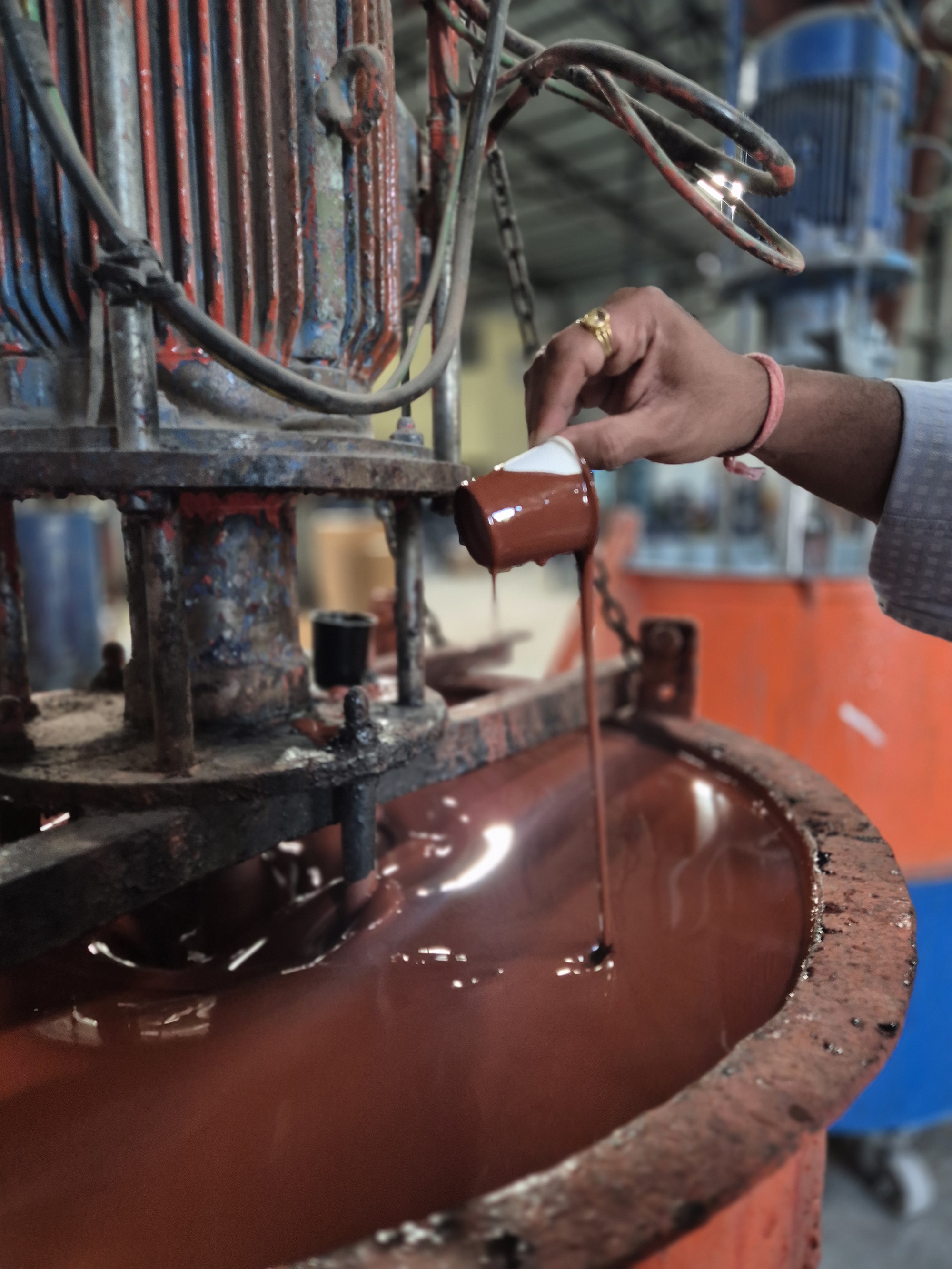 | Expoxy Paint Epoxy Paints –The Ultimate High-Performance Coating for Industrial & Commercial Protection Epoxy paints have become the top choice for industries,... View product → |
 | Expoxy Paint Epoxy Primer – The Most Reliable Base Coat for Industrial Protection & Strong Adhesion When it comes to industrial painting, durability starts from... View product → |
Frequently asked questions
How do you classify epoxy coating damage before repair?
Separate isolated scratches, pinholes and impact chips from hollow, blistered, peeling or broadly debonded film. Repair a small defect only when the surrounding epoxy remains firmly bonded.
How far should you prepare an epoxy coating damage repair?
Mark the visible boundary, clean the area, tap for hollow sounds and remove loose material. Cut back the edge where needed until the remaining coating is sound and firmly attached.
How do you match a replacement coating to existing epoxy paint?
Confirm the existing coating type, primer requirements, surface preparation method, colour and recoat window. Use a compatible repair system rather than relying on colour matching alone.
When should you apply an epoxy coating repair?
Apply only within the repair product’s specified temperature, humidity, substrate-moisture and recoat limits. Keep the area clean and dry until the coating reaches its stated cure condition.
Related product
 | Expoxy Paint High-Performance Protection for Steel Structures When it comes to long-term corrosion protection of metal surfaces, Epoxy Zinc Rich Primer is one of... View product → |