
A failed black coating does not tell you whether moisture, corrosion, contamination, trapped solvent, or poor intercoat adhesion caused the damage. By the end, you will be able to compare epoxy coal tar black with competing systems, classify the failure, and choose a recovery method based on the substrate, service exposure, and condition of the retained film.
Key takeaways
- Identify blistering, corrosion, and adhesion loss before selecting a repair.
- Prepare steel to remove rust and concrete to expose sound material.
- Control dew point, film thickness, recoat windows, and holidays during application.
- Use patching, full recoating, or replacement based on failure extent.
What Epoxy Coal Tar Black Is—and Where It Fits Among Protective Coatings
Epoxy paints coal tar black are normally two-component epoxy–coal-tar systems, not ordinary black epoxy. The epoxy resin supplies adhesion and chemical resistance; coal-tar-derived components improve water immersion, salt, buried-service resistance, and film flexibility. Curing depends on resin–hardener mixing, temperature, ventilation, and recoat timing, while maintenance includes inspection for blistering, corrosion, and adhesion loss.
| System | Best fit | Main trade-off |
|---|---|---|
| Coal-tar epoxy | Buried steel, immersed concrete, wastewater, marine and underground service | Strong immersion barrier; commonly chalks and fades in sunlight |
| Standard epoxy paint | Atmospheric steel, prepared concrete and many chemical services | Better appearance than coal-tar epoxy, but UV exposure can chalk it |
| Epoxy zinc-rich primer | Atmospheric steel corrosion control beneath a compatible build coat | Zinc protects steel sacrificially; it is not an immersion-grade barrier or complete finish |
| Bituminous coating | Buried steel and damp, low-cost barrier work | Flexible and water-resistant, but weaker for chemical exposure, adhesion and inspection |
| Chlorinated rubber | Atmospheric or intermittently wet service needing faster curing | Less suitable for demanding immersion and high-temperature chemical service |
| 2K polyurethane | UV-exposed areas, atmospheric steel and appearance-critical work | Excellent colour and gloss retention; requires compatible preparation and recoating |
The generic word epoxy and black colour reveal little. Compare solids, solvent content, cure speed, permitted service temperature, dry-film thickness and chemical schedule on the technical data sheet.
Coal-tar epoxy suits immersion and buried service, but sunlight commonly causes chalking and fading. Standard epoxy or 2K polyurethane fits exposed areas better where appearance and UV retention matter; a zinc-rich primer still needs a compatible barrier system above it.
Read the Failure Before You Choose an Epoxy Coal Tar Black Recovery
A repair decision starts with failure classification, not immediate overcoating. Photograph each area before disturbing it, recording blister size, peeling, cracking, pinholes, rust staining, gloss loss, and adhesion loss.
| Location | Cross-sectional clue | Likely origin |
|---|---|---|
| Substrate | Rust, damp concrete, or salt at the surface | Corrosion or osmotic bubbling |
| Primer | Primer separates from steel or concrete | Substrate preparation or primer failure |
| Intercoat boundary | Clean split between two coats | Contamination or overcoating incompatibility |
| Topcoat | Chalking, cracks, pinholes, or surface softness | Weathering, cure, thickness, or application error |
Open every blister with a knife and widen the cut until the coating grips firmly; sanding only its crown leaves the failed perimeter behind. Water beads, rust appears as orange-brown powder, soluble salts form crystals or test positive, and uncured material feels tacky, soft, or smells of solvent.
Osmotic bubbling points to water and salts; corrosion-driven lifting points to rust.
Excessive thickness or poor ventilation traps solvent beneath a skin, causing softness, amine blush, wrinkling, pinholes, prolonged cure, or delamination. Check for oil, salts, and dust; an aged film coated after its maximum recoat interval can be incompatible. Verify the two-component mixing ratio, and reject application made below the dew point.
UV chalking can be cosmetic; detached coating cannot remain. Use photographs, adhesion checks, and cross-sectional observations to choose a local patch, full-area recoat, or complete removal. These epoxy coal tar black problems determine epoxy paints coal tar black recovery.
Prepare Concrete and Steel So the Repair Has a Sound Boundary
1. Start by recording the information needed for epoxy paints coal tar black repair: substrate type; immersion status; chemical; water temperature; coating age; dry-film thickness; coat count; primer type; preparation history; and failure photographs. Without these details, epoxy paints coal tar black recovery becomes a compatibility guess.
2. On concrete, remove laitance, curing compounds, oil, salts, loose material, and dampness before coating. Verify dryness and surface condition; do not coat over dark or cool patches that indicate retained moisture.
3. On steel, remove rust, mill scale, loose coating, weld spatter, sharp edges, salts, and failed primer. Trace removal to a firmly bonded boundary, because coating left loose at the edge will lift beneath a sound-looking patch.
4. Choose abrasive blasting for immersed or severely corroded service unless the specification says otherwise. Use power-tool cleaning for sound, localised repairs only when the specification permits it. SSPC-SP 10/NACE No. 2 and SSPC-SP 5/NACE No. 1 are possible blast-cleanliness specifications, not universal defaults.
5. Verify the prepared surface before mixing paint through visual inspection, surface-profile measurement with replica tape or a profile gauge, and soluble-salt testing using ISO 8502-6 extraction with ISO 8502-9 conductivity measurement. Set cleanliness, profile, and salt limits from the project specification; a clean-looking black surface is not proof that salts are absent.
Control Thickness, Dew Point, Recoat Windows, and Holiday Detection
A repair fails again when moisture, incompatible curing, or uncontrolled thickness is hidden beneath a black surface. Log air temperature, relative humidity, steel temperature, and calculated dew point.
Keep steel at least 3 °C above dew point during preparation and application unless the product data sheet sets a stricter limit; otherwise condensation can cause flash rust and poor adhesion.
Use the current technical data sheet for every epoxy paints coal tar black repair. Confirm:
- Mixing ratio, induction time, pot life, and thinner restrictions
- Minimum substrate temperature and maximum wet-film thickness
- Required dry-film-thickness range and recoat interval
- Ventilation requirements and curing conditions
A thick or solvent-rich film in cool, damp, poorly ventilated conditions can skin over while retaining solvent underneath. The result is softness, amine blush, wrinkling, pinholes, prolonged cure, or later intercoat delamination. Many epoxy coal tar black problems begin with treating a product-specific limit as a generic rule.
Overlap only onto tightly bonded, cleaned, mechanically abraded coating. Feather sharp edges, then stripe-coat welds, corners, bolts, and edges to prevent thin spots. For immersion service, map dry-film thickness and choose low-voltage wet-sponge or high-voltage holiday testing based on cured thickness, conductivity, and the applicable equipment standard.
Contain coal-tar removal dust, ventilate the work area, and specify suitable respiratory and skin protection. Collect contaminated abrasive, sludge, filters, and disposable clothing as controlled waste; heating, burning, or aggressive removal can release hazardous dust and fumes.
Choose Between Local Patching, Full Recoating, and Replacement Systems
Keep the existing barrier only when adhesion, cure state, contamination, coating identity, and service compatibility are documented. A local epoxy paints coal tar black repair is justified when damage is isolated, surrounding film passes adhesion testing, and the exposed boundary can be cleaned, abraded, feathered, and inspected.
Use a broader strip when blisters connect beneath apparently sound coating, salts or rust extend beyond the visible defect, the film is soft, or the maximum recoat interval and coating identity are unknown.
Take adhesion measurements and core samples through sound and failed areas; on a critical asset, return it to service only after holiday testing and dry-film-thickness mapping. Repeat immersion failure usually makes full removal and a qualified replacement system cheaper than another patch.
| Option | Immersion and chemical service | Atmosphere, UV, and recovery |
|---|---|---|
| Coal-tar epoxy | Strong barrier for water, buried steel, salts, and selected chemicals; verify the specification | Chalks in sunlight; dark film complicates visual inspection and needs thickness and holiday testing |
| Bituminous coating | Flexible water barrier, weaker chemical and mechanical performance | Simple repairs, poor UV and solvent resistance |
| Chlorinated rubber | Useful for some water and atmospheric services; chemical limits vary | Easier maintenance, but weaker high-performance chemical protection |
| Standard epoxy | Strong adhesion and chemical resistance; formulation may not suit continuous immersion | Better general atmospheric use; chalks under UV |
| Zinc-rich primer | Corrosion-control primer, not a complete immersion barrier | Needs compatible overcoat; inspection focuses on coverage and continuity |
| 2K polyurethane | Limited by product specification in immersion; strong atmospheric finish | Best UV and colour retention; repairs demand strict compatibility |
For epoxy paints coal tar black recovery, Pragati Paints & Allied Products can help compare coating, primer, thinner, compatibility, and documentation against the service specification. Use the current technical data sheet and project requirements, not colour, to choose.
Related product
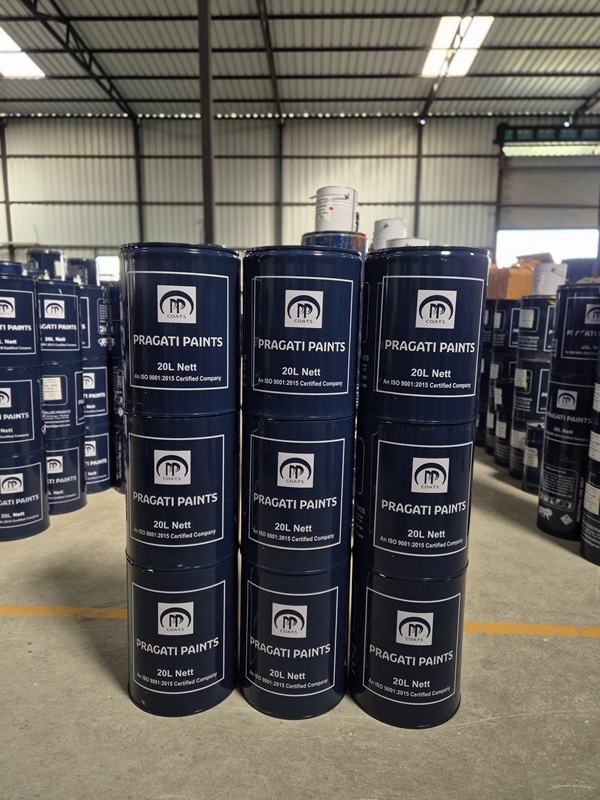 | Expoxy Paint Heavy-Duty Protection for Steel & Concrete in Immersed Conditions When steel or concrete structures are continuously exposed to water, chemicals, or... View product → |
Frequently asked questions
What is epoxy coal tar black used for?
Epoxy coal tar black is a two-component protective coating used where water immersion, salt exposure, buried service, and corrosion resistance matter.
How do you diagnose epoxy coal tar black coating failure?
Inspect for blistering, rust breakthrough, cracking, chalking, and adhesion loss, then identify whether the failure is in the coating, substrate, or service conditions.
How should steel and concrete be prepared for epoxy coal tar black repair?
Remove loose coating and corrosion from steel, expose sound concrete, clean contaminants, and create a sound, properly profiled boundary around the repair.
What application controls prevent epoxy coal tar black repair failure?
Check substrate temperature and dew point, mix the two components accurately, apply the specified film thickness, observe recoat windows, and detect holidays before service.
When should you patch, recoat, or replace an epoxy coal tar black system?
Patch isolated damage with sound surrounding coating, recoat when failure is widespread but the substrate remains sound, and replace the system when substrate deterioration or incompatibility is extensive.