Fast drying can rescue a steel maintenance job only when the substrate, existing coating, primer, film thickness and service conditions suit a thermoplastic chlorinated-rubber system. You will be able to identify likely failure causes, prepare steel correctly, set realistic drying and recoating controls, and decide when another coating system is safer.
Key takeaways
- Use chlorinated rubber paint for suitable atmospheric steel repairs, not every exposure.
- Remove rust, salts, oil and loose coating before applying an emergency film.
- Check primer, old paint and wet-film thickness against the product TDS.
- Control temperature, humidity, recoating windows and solvent evaporation to prevent defects.
Which steel maintenance jobs suit chlorinated rubber paint—and which do not?
Speed is a valid reason to choose chlorinated rubber paint only for suitably prepared atmospheric steel repairs where the product TDS permits the exposure. Its thermoplastic binder forms a film mainly through solvent evaporation, so it dries initially and recoats without the induction time required by many two-pack systems.
The same mechanism creates limits. Strong solvents and aromatic blends can soften or swell the film, while heat can reduce adhesion and leave it vulnerable to handling damage.
| Option | Decision | Reason |
|---|---|---|
| Atmospheric steel repairs | Suitable when the TDS approves the service | Fast recoating supports quick-turnaround maintenance |
| Continuous immersion | Do not default to it | Require immersion data for the actual liquid |
| Strong chemical service | Do not default to it | Solvent and chemical attack can soften or swell the binder |
| Heavy abrasion | Do not default to it | A harder, tested system may be necessary |
| Steel around 60–80 °C or above | Use only with manufacturer service data | Heat can soften, print or detach the film |
A dry surface is not a fully cured film. Heat, solvent exposure, stacking, tightening contact surfaces and rough handling can still damage it before the specified service interval.
Treat chlorinated rubber paint problems as system-selection warnings, not simple drying failures:
- Blistering, peeling and poor adhesion can indicate salts, moisture, incompatible old paint or inadequate preparation.
- Wrinkling and solvent entrapment can indicate excessive thickness or solvent attack.
- Flash rust, chalking and premature corrosion can show contaminated steel, wet conditions, ultraviolet exposure or an unsuitable grade.
How to prepare steel before a fast emergency coating
Sufficient preparation means removing contamination, unstable material and moisture before the chlorinated-rubber system touches the steel. Use this sequence:
1. Remove oil and grease with a cleaner confirmed compatible with the coating system. Residual oil causes poor adhesion even when the steel looks bright.
2. Remove mill scale, loose rust and failed paint. Use abrasive blasting when the specification and corrosion severity require it; for suitable maintenance work, use power-tool cleaning to St 2 or St 3 under ISO 8501-1.
3. Vacuum or wipe away abrasive dust and debris. Dust left in pits or on edges becomes a weak layer beneath the repair coat.
4. Inspect welds, sharp edges, pits and rust stains. These areas expose preparation gaps first and often become the starting points for peeling or premature corrosion.
5. Test soluble salts when blistering risk matters. Visually clean steel can still carry chlorides, especially in coastal or humid Mumbai conditions; use ISO 8502-6 for extraction and ISO 8502-9 for field measurement.
6. Coat only dry steel with no visible condensation. Measure steel temperature, air temperature and relative humidity, then confirm that steel is at least 3 °C above the dew point before and throughout application.
7. Remove flash rust formed after wet cleaning and reinspect the surface. Do not immediately overcoat it; chlorinated rubber paint problems will return if moisture or contamination remains.
How primer, old paint and film thickness create compatibility failures
The safest undercoat is the one tested as part of the complete coating system, not the one chosen by coat count or drying speed.
| Option | What it means | When it applies |
|---|---|---|
| Chlorinated-rubber primer | Matched thermoplastic system | Trial with its specified chlorinated-rubber topcoat |
| Q.D. primer | Quick-drying primer with conditional compatibility | Use only when its TDS expressly approves chlorinated-rubber overcoating and states the recoat window |
| Zinc phosphate primer | Atmospheric-steel anticorrosion undercoat | Use when the compatible system covers normal atmospheric exposure |
| Epoxy zinc-rich primer | High-performance corrosion foundation | Use only when the full specification approves the thermoplastic topcoat over it |
Old paint can create the failure. Solvent-sensitive binders can soften, wrinkle or lift under chlorinated rubber paint, while chalked films can lose adhesion. Perform a solvent-rub check, then apply a small compatibility and adhesion trial on the actual substrate, including edges, welds and rusted areas.
Do not treat two-pack epoxy or polyurethane as an automatic upgrade over chlorinated rubber paint. Their solvents can attack the thermoplastic film, and its movement can cause lifting; remove the old coating or use a manufacturer-approved tie coat and system.
Control thickness during the trial. Take wet-film readings under ASTM D4414 and dry-film measurements under ASTM D7091; two coats do not prove the required thickness. These checks expose excessive build, solvent entrapment and uneven coverage before widespread chlorinated rubber paint problems appear.
What drying, recoating and application controls prevent emergency defects?
Fast initial drying does not make a thick coat ready for service. Apply quickly without trapping solvent by following the product TDS, not generic drying figures.
1. Confirm the TDS limits for air and steel temperature, relative humidity, approved thinner, wet-film thickness, dry-film thickness, number of coats, recoat interval and service interval. Use only the specified chlorinated-rubber thinner.
2. Apply thin, even coats at the stated wet-film thickness. Verify the resulting dry-film thickness with the project requirement; excessive film build, low temperature, high humidity, poor ventilation and a solvent-rich undercoat all extend evaporation time.
3. Allow ventilation and the full TDS recoat or service interval. A surface that feels dry can still retain solvent, so do not stack components, tighten bolted contact surfaces, handle aggressively or immerse the steel before the interval ends.
4. Inspect each coat for chlorinated rubber paint problems: wrinkling suggests solvent attack or excessive thickness; blisters suggest moisture, soluble salts or trapped solvent; a soft film suggests incomplete evaporation or heat exposure. Flash rust indicates wet or contaminated steel, while early chalking points to ultraviolet exposure or an unsuitable grade.
Stop work when defects spread. Isolate the affected area, identify the cause, and test the surface and coating before recoating; covering an active defect only buries the failure.
How to troubleshoot a failed film and verify the replacement system
Start by locating the failure, not by ordering another coat. Inspect its location and pattern, then separate causes with evidence rather than guessing from appearance.
- Test adhesion on sound and failed areas using the project method.
- Perform a solvent-rub check to identify soft or solvent-sensitive layers.
- Measure dry-film thickness across blistered, wrinkled and sound zones.
- Check for soluble salts, oil, dust and dew-point records.
- Compare the batch label, TDS, SDS, approved thinner, recoat window and service-temperature limit.
Remove loose or blistered coating, feather sound edges, clean contamination and repeat the specified preparation. Do not bury active failure under another coat; trapped contamination will return beneath the replacement film.
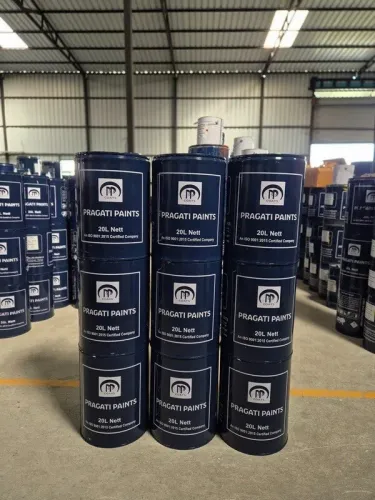
For chlorinated rubber paint availability, confirm the complete system rather than a similar product name. Pragati Paints & Allied Products can provide a local stock-check point for a buyer searching for a chlorinated rubber paint supplier in Mumbai, but request documents and inspect the actual materials before dispatch.
| Option | Verify | Reject or hold |
|---|---|---|
| Specified system | Primer, topcoat, colour, thinner and matching batch | Substitute grade, missing label or damaged tin |
| Replacement approval | Current TDS, SDS, recoat window and service-temperature limit | No written compatibility approval |
| Trial patch | Actual substrate, old coating, welds, edges and rusted areas | Full application without testing |
| Final decision | Measure adhesion and film thickness after the patch cures | Proceeding while blistering or solvent sensitivity remains |
Require a trial patch and written compatibility approval before dispatch. Availability is not proof of compatibility.
Related products
 | Q.D. Paints & Primer High-Performance Protective Coating for Industrial & Marine Applications. View product → |
 | Q.D. Paints & Primer Q.D. Paints Fast-Drying Industrial Coatings for Quick & Efficient Protection In fast-paced industrial environments, reducing downtime while ensuring high-quality... |
Frequently asked questions
Which steel maintenance jobs suit chlorinated rubber paint?
It suits suitably prepared atmospheric steel repairs when the product TDS permits the exposure. Do not select it for conditions the TDS excludes, such as incompatible immersion or chemical service.
How should steel be prepared before applying chlorinated rubber paint?
Remove rust, mill scale, oil, salts, dust and loose paint, then create the surface profile required by the specified primer and coating system.
Why do primer and old paint cause chlorinated rubber paint problems?
A primer or existing film can soften, wrinkle, lift or lose adhesion when its binder is incompatible with the solvent blend or thermoplastic topcoat. Confirm compatibility before application.
What application controls prevent emergency coating defects?
Follow the TDS for temperature, humidity, thinning, wet-film thickness, drying time and recoating interval. Ensure solvent evaporation is possible before exposing the film.
How do you verify a replacement steel coating system after failure?
Identify the failure mode, remove unsound material, confirm surface cleanliness and profile, then verify the replacement system through TDS instructions and adhesion, thickness and visual checks.
Related products
 | Industrial PU Paint High-Performance Polyurethane Coating for Industrial Applications Industrial PU Paint RAL 6037 is a premium-grade polyurethane-based coating designed... View product → |
 | Expoxy Paint High-Performance Protection for Steel Structures When it comes to long-term corrosion protection of metal surfaces, Epoxy Zinc Rich Primer is one of... View product → |
 | Heat Resistance (H.R) Paint High Temperature Resistant Industrial Coating H.R. Paint @ 600°C is a high-performance heat resistant coating specially formulated to withstand... View product → |
 | Q.D. Paints & Primer Q.D. Primer Fast-Drying Primer for Industrial & Metal Surface Protection In industries where speed, efficiency, and reliable protection are essential, Q.D. |