Epoxy earns its place on machinery only when the substrate, operating conditions, preparation standard and curing time match the coating system. You will be able to compare epoxy with faster or more flexible alternatives, calculate the real maintenance cost, and specify the evidence needed before purchase.
Key takeaways
- Match epoxy to oils, chemicals, temperature, moisture, and downtime limits.
- Remove rust, oil, salts, and weak old paint before coating.
- Use the specified primer, epoxy coats, and recoat window as one system.
- Compare labour, preparation, downtime, and recoating costs—not paint price alone.
Start with the machine’s service conditions, not the word epoxy
Epoxy paints for machinery suit steel housings, skids, frames and tanks when adhesion, film build and resistance to oils, fuels or chemicals matter more than rapid return to service. For epoxy for paints machinery maintenance, judge the coating against the machine’s actual service conditions, not its label.
Check these conditions before choosing:
- Metal type, existing coating and any galvanic contact
- Continuous and cycling temperatures against the product’s rated range
- Oil, fuel, solvent, chemical, moisture or immersion exposure
- Abrasion, impact, vibration, flexing and sharp edges
- Outdoor ultraviolet exposure and the available downtime for curing
Epoxy can soften, embrittle or lose adhesion outside its temperature range. It also fails over damp or oil-contaminated steel, and it cannot stop corrosion caused by leaking seals, trapped water, chloride deposits or poorly prepared welds. Repair those sources first.
Continuous sunlight needs a UV-stable topcoat; moving parts and strongly vibrating assemblies need a more flexible system.
| Option | Main trade-off | Better choice when |
|---|---|---|
| Two-component epoxy | Strong adhesion and chemical resistance, slower cure | Steelwork exposed to oils, chemicals and abrasion |
| Synthetic enamel or alkyd | Faster, simpler repair; lower chemical resistance | Dry machinery needing economical cosmetic maintenance |
| Polyurethane | Better UV and gloss retention; higher application sensitivity | Outdoor equipment requiring colour retention |
| Direct-to-metal coating | Fewer layers and quicker work; preparation remains critical | Sound, lightly rusted steel with limited downtime |
| Galvanic zinc system | Sacrificial corrosion protection; less suited to impact or chemical service | Exterior steel where corrosion protection outranks finish |
Preparation decides whether the maintenance coating survives
Oil, rust and weak old paint can defeat an epoxy maintenance coating before it has cured. For epoxy paints maintenance coating work, prepare the equipment as carefully as you would specify the product.
- Isolate, depressurise and cool the machine. Remove guards where they block access, and repair leaking seals, drains, weld defects or crevices that supply water or oil.
- Degrease the surface with a cleaner suitable for the contaminant, then remove the residue. Solvent-wiping over grease spreads contamination instead of removing it.
- Remove rust, mill scale, blistered areas and loose coating by abrasive blasting, power tooling or hand tooling to the cleanliness and profile stated on the product data sheet. Feather sound old paint around bare patches.
- Test the remaining coating for adhesion and compatibility. Cross-cut testing, a small trial patch and inspection for softening after cleaning expose old paint that will pull the new film away.
- Vacuum or blow away dust with clean, dry air, then check for soluble salts if the machine has seen marine exposure, process chemicals or repeated wetting. Wash or reprepare contaminated areas.
- Apply only to dry steel. Keep the steel at least 3°C above the calculated dew point during preparation, coating and early cure; condensation under the film causes blistering and early loss of adhesion.
Epoxy paint machinery protection cannot repair active corrosion beneath a clean-looking film. Record the surface condition, preparation method, weather readings and remaining old coating before mixing the two components.
Build the complete coating system and apply it within its limits
Select a primer that matches both the exposed metal and the existing sound coating. Use a zinc-rich primer for suitably prepared steel where corrosion protection is the priority; use an epoxy primer for adhesion and barrier protection over prepared steel or compatible old paint.
Choose an epoxy finish for chemical resistance and film build, then add a UV-stable polyurethane topcoat for outdoor machinery. For an epoxy paints maintenance coating, confirm compatibility, service temperature and immersion limits on the product data sheet.
- Verify the batch numbers, resin-to-hardener ratio, pot life and permitted thinner before opening the kits.
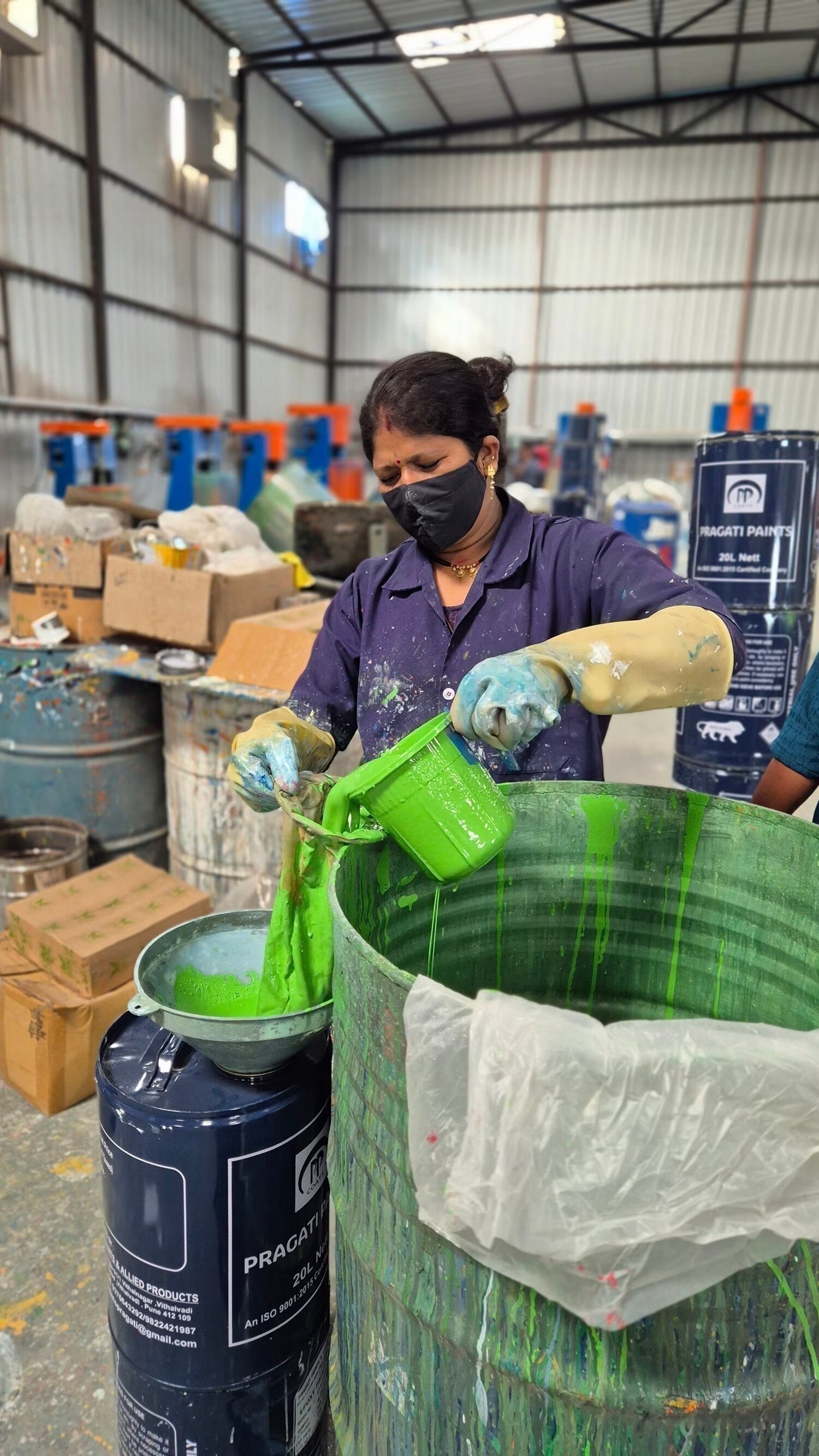
- Stir each component separately, combine the full units at the stated ratio, and mix mechanically until the colour and texture are uniform.
- Allow the specified induction time, if the data sheet requires one, then use the mixture before its pot life expires; do not revive thickening material with extra thinner.
- Apply the specified wet-film thickness, checking it with a wet-film gauge; confirm cured dry-film thickness after application.
- Keep steel at least 3°C above the calculated dew point during preparation, coating and early cure. Follow the product’s limits for air temperature, substrate temperature and relative humidity.
Recoat within the stated minimum and maximum window. Early recoating can trap solvent; late recoating demands cleaning and abrasion for intercoat adhesion. Epoxy paints for machinery also need sufficient cure before loading, washing or returning the equipment to service.
Price the whole maintenance job, not just the paint
A paint quote is incomplete until it includes preparation, access, curing and lost production. The economics of epoxy paint machinery protection improve when you have a worthwhile shutdown window and a sound substrate; they deteriorate when the machine needs rapid return to service or failed film will require removal.
Price these items before choosing the coating:
- Labour for isolation, depressurising, degreasing, rust removal, mechanical abrasion or blasting, masking, mixing, application and inspection.
- Equipment for scaffolding or lifts, ventilation, abrasive blasting, dust control, solvent handling, dew-point measurement and dry-film-thickness checks.
- Downtime for surface preparation, primer and finish application, recoating intervals, final cure and access removal. Compare that total with the machine’s hourly production value.
- Purchasing details: resin-to-hardener pack size, theoretical coverage at the specified film thickness, expected wastage, thinner, primer compatibility, shelf life, batch number and delivery time.
- Rework exposure if oil remains in the steel, moisture enters the film or the coating is applied outside its temperature and humidity limits. A cheap product becomes expensive after premature recoating.
For epoxy for paints machinery maintenance, ask the supplier for the technical data sheet, mixing ratio, pot life, recoat window, service-temperature range and chemical-resistance test conditions. Pragati Paints & Allied Products can help you compare an epoxy primer and finish against the preparation and cure requirements rather than comparing drum prices alone.
Choose epoxy when its longer service interval justifies the labour and shutdown. Choose a faster single-pack repair coating when curing time, not durability, controls the decision.
Related products
 | Expoxy Paint Epoxy Paints –The Ultimate High-Performance Coating for Industrial & Commercial Protection Epoxy paints have become the top choice for industries,... View product → |
 | Expoxy Paint Epoxy Primer – The Most Reliable Base Coat for Industrial Protection & Strong Adhesion When it comes to industrial painting, durability starts from... View product → |
Inspect the finished film and keep evidence for the next shutdown
A coating works when the cured film is continuous, bonded and thick enough for the specified system. Inspect it before returning the machine to service: check for pinholes, runs, missed edges, blisters, cracking, rust staining, delamination and soft or tacky areas.
Measure dry-film thickness with a calibrated gauge and compare readings with the product specification; ISO 19840 provides a recognised method for steel coatings.
Judge epoxy paint machinery protection by the film’s condition, not its colour. Test adhesion on a representative area with a cross-cut or pull-off method when the specification requires it.
Reinspect after the first operating cycle, then at each planned shutdown; early rust creep from scratches, blistering near welds, chalking outdoors or repeated edge lifting signals moisture, contamination, movement or a temperature problem beneath the surface.
Keep a job record that another technician can audit:
- Machine and component identification, metal condition and preparation method
- Product names, batch numbers, mix ratio, thinner, application dates and applicator
- Steel temperature, air temperature, relative humidity, dew point and clearance above dew point
- Wet-film or dry-film readings, adhesion results, defects, photographs and repair locations
- Labour hours, access equipment, downtime, material quantity and cure time
At the next shutdown, compare this record with repair hours, recoating area and service interval. Record whether the epoxy paints maintenance coating prevented corrosion for the planned period without costly rework. If it failed early, include removal and downtime costs; that figure—not the tin price—decides whether the system justified its cost.
Frequently asked questions
When are epoxy paints for machinery a suitable choice?
Choose epoxy when machinery surfaces need strong adhesion, substantial film build, and resistance to oils, fuels, chemicals, or corrosion. Check temperature, sunlight, moisture, and return-to-service limits before selecting it.
How should you prepare machinery before applying an epoxy maintenance coating?
Degrease the surface, remove salts and rust, abrade or blast steel, eliminate loose old paint, and leave a clean, dry profile that the specified primer can anchor to.
What should a complete epoxy paint system for machinery include?
Specify the compatible primer, epoxy build coats, thinner if permitted, film thickness, mixing ratio, pot life, recoat window, curing conditions, and topcoat where sunlight or chemical exposure requires one.
How do you calculate the real cost of epoxy paint machinery protection?
Add coating materials to labour, abrasive cleaning, masking, access equipment, waste, ventilation, inspection, curing time, production downtime, and future recoating.
Related products
 | Expoxy Paint High-Performance Protection for Steel Structures When it comes to long-term corrosion protection of metal surfaces, Epoxy Zinc Rich Primer is one of... View product → |
 | Industrial Expoxy Paint Epoxy High Build Zinc Phosphate Primer Advanced Corrosion Protection for Industrial Steel Structures Industrial environments demand coatings that deliver long-lasting corrosion protection,... View product → |
 | Synthetic Paints & Primer Durable, Affordable & Versatile Coating Solution for All Surfaces Synthetic paints are among the most widely used industrial and household coatings... View product → |
 | Expoxy Paint Premium Anti-Corrosive Protection for Industrial Metal Surfaces When industries need the highest level of corrosion resistance and strong adhesion,... View product → |