
Rain alone does not determine whether a polyurethane coating will protect machinery in Chennai. You need to match the resin, primer system, surface preparation, film thickness and application conditions to the equipment’s actual exposure, then confirm the limits in the technical data sheet.
Key takeaways
- Specify the full coating system against the site’s ISO 12944 corrosivity category.
- Measure steel temperature, air temperature, humidity and dew point before coating.
- Check water, heat and chemical exposure before selecting P U Aeromatic for machinery.
- Approve a test panel and inspect adhesion, film thickness and curing before production use.
When P U Aeromatic paint can protect machinery in Chennai
P U Aeromatic can protect machinery through Chennai’s monsoon when it is specified for the site’s ISO 12944 corrosivity category and applied as part of a compatible corrosion-control system. If your search is “can p u aeromatic paint for protect machinery through monsoon weather in chennai”, the product name alone proves nothing.
Approval requires these parts to be specified together:
- Cleaned and prepared substrate
- Compatible corrosion-resistant primer
- Intermediate coat with the required dry-film thickness
- Polyurethane finish suitable for the service exposure
Repeated wetting and drying, condensation, retained water in crevices and marine chlorides near the coast can drive corrosion beneath a weak system. Rain and occasional splash are atmospheric exposure; standing water, ponding and continuous immersion require specific resistance data and cannot be assumed from rain resistance.
| Exposure | What to verify | Risk if mismatched |
|---|---|---|
| Atmospheric rain and splash | ISO 12944 category and complete coating system | Rusting at defects, edges and fasteners |
| Crevices and retained water | Drainage, stripe coating and water-resistance data | Blistering and under-film corrosion |
| Standing water or immersion | Explicit immersion approval and full-cure time | Softening, delamination and rapid failure |
If “aeromatic” means aromatic polyurethane, the cured film can provide a barrier but may yellow or chalk under prolonged ultraviolet exposure. Choose aliphatic polyurethane when long-term colour and gloss retention matter. Condensation and salt-laden air still demand correct preparation, primer selection and film thickness.
Choose the machinery surfaces and coating system before buying the finish
P U Aeromatic for machinery suits fixed, exposed surfaces such as outdoor steel frames, pump housings, tanks, platforms and non-immersed concrete bases when the complete coating system is approved. Use the sequence of prepared substrate, compatible primer, intermediate coat and polyurethane finish; the finish alone does not establish corrosion protection.
| Surface or application | Usual decision | Separate confirmation required |
|---|---|---|
| Outdoor steel frames | Suitable candidate for atmospheric exposure | ISO 12944 corrosivity category and system thickness |
| Pump housings and tanks | Suitable when rain and splash are controlled | Ponding, immersion, process chemicals and operating temperature |
| Control panels and platforms | Suitable for fixed external faces | Electrical-enclosure sealing, heat and maintenance access |
| Concrete bases | Possible over a compatible concrete system | Moisture vapour, alkalinity, cracks and standing water |
| Moving parts and bearing areas | Do not coat working or close-clearance surfaces | Manufacturer’s clearance, lubrication and friction limits |
| Hot, vibrating or electrical assemblies | Not an automatic approval | Temperature, vibration, insulation and enclosure requirements |
For new or heavily corroded carbon steel, abrasive blast cleaning to Sa 2½ under ISO 8501-1 is a common high-performance preparation grade. Confirm the specified surface profile, then remove oil, loose coating, mill scale and visible rust.
On old machinery, test for soluble chlorides and record the project’s stated salt acceptance limit; trapped salts can cause osmotic blistering beneath the new film.
Apply a stripe coat to edges, welds, bolts and recesses before the full coats. Measure dry-film thickness across broad flats and difficult features, because coverage calculations do not prove protection. Reject the system for this service until its data sheet identifies the compatible primer, recoat window and chemical or immersion limits.
Control humidity, dew point and curing during Chennai monsoon application
Polyurethane paint for wet weather in Chennai describes a cured film’s service tolerance, not permission to apply it while rain is falling. Apply only to a dry, clean substrate with suitable ventilation, and shelter machinery from rain, condensation and wash-off until the specified rain-resistance period and full cure have passed.
Before and during each shift, control these conditions:
- Measure air temperature, steel temperature, relative humidity and dew point.
- Keep steel at least 3°C above dew point to prevent invisible condensation.
- Stay within the product data sheet’s humidity and application-temperature limits. An 85% relative-humidity ceiling is common on projects, not universal approval.
- Stop work when rain protection fails or condensation forms.
Early water exposure can produce:
- Blushing or surface haze
- Pinholing and gloss defects
- Poor intercoat adhesion
- Premature blistering
Follow the product data sheet for the stated two-component mixing ratio, induction time, pot life and approved thinner. Extra thinner or hardener can reduce film build and alter cure, so it is not a humidity workaround.
Record the minimum and maximum recoat interval, specified dry-film thickness and full-cure time. Recoat too soon and trapped solvent can disrupt the film; recoat after the maximum interval and abrasion may be needed for adhesion. Dry-to-touch only means the surface feels dry—it does not establish cure.
Match P U Aeromatic monsoon protection to water, heat and chemical exposure
Rain resistance is not enough for machinery exposed to Chennai monsoon service. Match the coating to the actual water contact, cleaning method, chemicals, operating temperature and vibration before approving p u aeromatic monsoon protection.
| Exposure | What to verify | Consequence of a mismatch |
|---|---|---|
| Atmospheric wetting or splash | Rain and splash resistance in the system data | Water may enter joints or damage weak edges |
| Ponding or continuous immersion | Specific ponding or immersion rating and duration | A rain-resistant film can blister or lose adhesion |
| Steam cleaning or wash-down | Steam, pressure, temperature and detergent resistance | Heat and chemicals can soften or lift the film |
| Hydraulic fluids, fuels, solvents or process chemicals | Named chemical-resistance data at the expected temperature | Spills can swell, stain or penetrate the coating |
Control the machinery as well as the paint. Clear drain traps, repair horizontal ledges and seal or redesign crevices where water can remain against the film. Record vibration and the hottest operating surface; movement and heat can expose defects that rain alone will not reveal.
Ask Pragati Paints & Allied Products for the product data sheet and system specification, then compare them with measured site conditions. Check for:
- Aromatic or aliphatic resin, recommended primer and preparation grade
- Maximum soluble-salt level, temperature and humidity limits
- Required dry-film thickness, recoat window and full-cure time
- Immersion, wash-down and named chemical-resistance data
A dry-to-touch film is not proof of service readiness. If the documents cover only atmospheric exposure, do not approve the system for ponding, immersion or chemical wash-down.
Related product
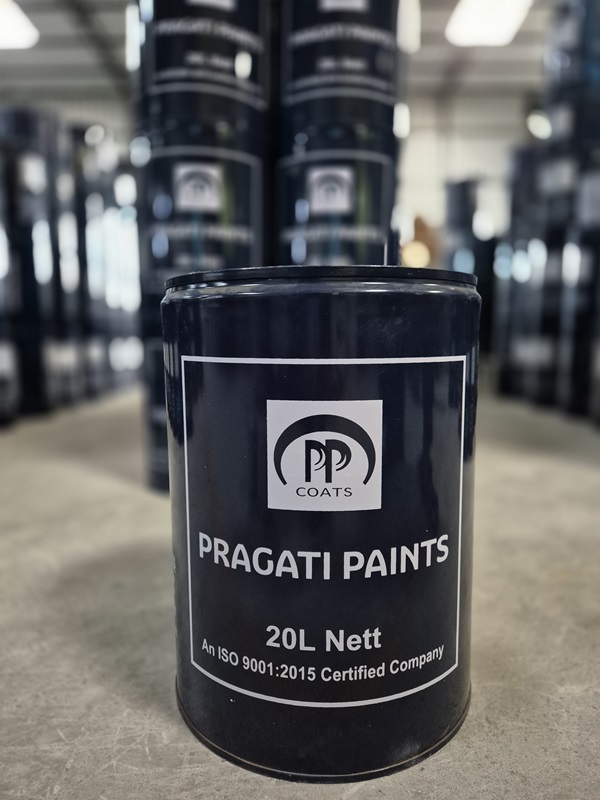 | Industrial PU Paint (Polyurethane Aromatic Paint) is a robust, high-strength industrial coating specially designed to provide excellent mechanical durability, chemical... View product → |
Use a site approval checklist before committing the machinery
Approve the job only when the site records, coating system and application conditions support the same service requirement.
1. Classify the location under ISO 12944. Do not assign one category to every Chennai site; record coastal chloride exposure and the site’s wet-dry pattern.
2. Record whether the machinery faces rain, splash, ponding, immersion, heat or process chemicals. A finish approved for atmospheric exposure is not automatically approved for immersion.
3. Inspect the existing coating for rust, peeling, chalking and poor adhesion. Test for soluble salts and compare the result with the maximum level stated in the system specification.
4. Specify the preparation grade, such as Sa 2½ under ISO 8501-1 where required, and record the target surface profile before painting.
5. Approve the primer, intermediate coat and P U Aeromatic polyurethane finish as one system. Check resin type, compatibility, service resistance and cure limits in the product data sheet.
6. Mark stripe-coat locations at edges, welds, bolts, corners and recesses. Confirm measured dry-film thickness on flat areas and difficult features.
7. Record air temperature, relative humidity, dew point and steel temperature for every application shift.
Reject the work if the substrate is wet, condensation is forming, rain protection is unavailable, the recoat window has expired without the required abrasion, or the data sheet does not cover the service.
P U Aeromatic is a defensible monsoon finish only when these records and limits support it. Otherwise, select a different resin or coating system.
Frequently asked questions
When can P U Aeromatic protect machinery in Chennai’s monsoon?
It can protect machinery when the complete coating system matches the site’s ISO 12944 corrosivity category and the applicator controls surface preparation, humidity, dew point and curing.
What should you check before choosing P U Aeromatic for machinery surfaces?
Identify each substrate, existing coating, operating temperature and exposure, then select compatible primers, intermediate coats and polyurethane finish rather than buying the finish alone.
How do humidity and dew point affect polyurethane paint application in Chennai?
Measure air temperature, steel temperature, relative humidity and dew point. Do not coat when condensation can form on the surface, and follow the product’s recoat and curing intervals.
What exposures must P U Aeromatic monsoon protection withstand?
Compare the coating system with the machinery’s contact with rainwater, standing water, heat, oils, solvents, acids, alkalis, abrasion and cleaning chemicals.