
The right primer depends on more than the label: corrosion exposure, metal type, existing coating, polyurethane topcoat and site conditions all change the specification. You will be able to narrow the system, define preparation and application controls, and compare quotations without relying on price per kilogram alone.
Key takeaways
- Classify the asset by wetting, condensation, pollutants and chemical exposure.
- Match the primer to steel, galvanised metal, aluminium or an existing coating.
- Confirm surface preparation, temperature, humidity and overcoating limits before purchase.
- Compare solids, coverage, pot life and recoat time—not just the product name.
Start with Pune’s corrosion exposure, not the primer name
Pune’s monsoon wetting, humidity, dust and industrial pollutants create different corrosion risks for different metal assets. A covered indoor frame faces atmospheric exposure; an outdoor structure exposed to condensation, chemicals or persistent wetting needs a stronger barrier system.
The practical answer to “which p u primer for fits metal project in pune” depends on exposure, expected service life, substrate and polyurethane topcoat—not on the word PU alone.
| Option | Choose it when | Important limit |
|---|---|---|
| Standard P.U. Primer | The prepared steel faces routine atmospheric exposure and the project needs a straightforward primer under a compatible PU finish | Do not select it as the sole barrier for condensation, chemical contact or severe corrosion duty |
| P.U. Zinc Phosphate Primer | Atmospheric steel needs corrosion-inhibiting pigment and more protection than a basic PU primer provides | It is not equivalent to an organic or inorganic zinc-rich primer, which provides sacrificial galvanic protection |
| Epoxy-plus-polyurethane system | Blasted steel will face industrial pollution, frequent condensation, chemicals or high durability demands | The epoxy supplies barrier protection; the PU finish supplies weathering and colour retention. Confirm the complete tested system |
For PU primer selection, identify whether the metal is bare mild steel, previously painted, galvanised, aluminium or stainless steel before buying. Each substrate can require a different primer or tie coat, and an old coating needs a compatibility check.
Request the current technical data sheet, compatibility statement and tested system designation. For a two-component product, obtain pot life at the expected Pune application temperature; warm mixed material can expire before its laboratory-rated pot life. Confirm the choice with a small site trial before full application.
Match the primer to the metal and existing coating
A polyurethane primer for metal is compatible only when its technical data sheet names the substrate and planned topcoat. “Direct-to-metal” does not prove adhesion to galvanised steel, aluminium or stainless steel; a carbon-steel primer can lift after initial weathering.
| Substrate | Suitable primer route | Compatibility decision |
|---|---|---|
| Bare mild steel | Standard P.U. Primer for light atmospheric duty; P.U. Zinc Phosphate Primer or epoxy under polyurethane for higher corrosion duty | Confirm the specified blast standard and topcoat system |
| Previously painted steel | Compatible P.U. primer or tie coat over sound, prepared paint | Check the old coating’s resin type, adhesion and solvent sensitivity; do not coat chalking or loose paint |
| Galvanised steel | Galvanised-metal primer or approved tie coat | Use the manufacturer’s cleaning and abrasion method, then verify adhesion on the actual zinc surface |
| Aluminium | Aluminium-specific primer or tie coat | Confirm compatibility with the alloy, pretreatment and polyurethane finish |
| Stainless steel | Stainless-steel primer or adhesion-promoting tie coat | Require a system statement for the grade and finish; ordinary steel primer is not enough |
Your p u primer selection must also account for the complete coating stack, not just the first coat. A two-component PU primer and a one-component moisture-cure product are different systems; do not substitute one without approval.
Before purchase, request:
- A current technical data sheet naming the substrate and recoat product.
- A compatibility statement for the existing coating, where applicable.
- A small trial on the actual metal and coating stack.
- Adhesion checks after curing, using ISO 2409 cross-cut testing or ISO 4624 pull-off testing where the project requires quantified results.
Specify preparation and weather limits before application
For anyone specifying p u primer in pune, approve the surface and weather conditions before approving the product. Bare carbon steel needs oil, grease, salts, mill scale, rust and loose old coating removed; degrease before abrasive blasting so contaminants are not driven into the profile.
- Blast carbon steel to ISO 8501-1 Sa 2½ for demanding protective systems. Measure the resulting surface profile against the primer’s technical data sheet, then remove abrasive dust and confirm the specified cleanliness before mixing.
- Mechanically abrade sound existing paint, feather sharp edges and remove flaking areas. Check adhesion and test a small patch with the proposed primer and polyurethane topcoat; incompatible binders can wrinkle, soften or lose adhesion.
- Clean galvanised steel, aluminium and stainless steel with the method specified for that substrate. Do not assume blast cleaning intended for carbon steel is safe for a thin zinc layer or a smooth non-ferrous surface.
- Apply only when the steel is dry and remains several degrees above the dew point. Record steel temperature, air temperature, relative humidity and dew point; monsoon humidity can create invisible condensation even when the air feels warm.
- Follow the product’s minimum and maximum application temperatures, humidity limit and recoat window. In warm Pune conditions, request two-component pot life at the actual site temperature and mixed volume; discard material after its pot life rather than adding thinner.
Recoating outside the stated window requires the specified sanding, abrasion or solvent cleaning. Dust, moisture or condensation during the wait can reduce intercoat adhesion.
Compare application data instead of relying on product labels
Compare quoted application data, not labels or price per kilogram. A reliable p u primer selection compares solids by volume, film thickness, application method, thinner demand, substrate limits and test evidence.
| Data point | What to compare | Why it matters |
|---|---|---|
| Dry-film thickness | Specified DFT per coat and total system DFT; verify with a calibrated gauge under ASTM D7091 | Excess thickness can crack or extend curing; low thickness leaves steel exposed |
| Wet-film thickness | WFT target that produces the stated DFT | Spraying by appearance alone creates uneven protection |
| Coats | Number of coats and whether each coat has a separate thickness target | One heavy coat is not equivalent to two controlled coats |
| Coverage | Theoretical coverage calculated from solids by volume and DFT, plus practical loss | A lower price can disappear through overspray and extra material |
| Recoat interval | Minimum and maximum times at the expected Pune temperature | Early recoating traps solvent; late recoating can weaken adhesion |
| Pot life | Mixed-material working time at the actual temperature and batch size | A warm, large mix can gel before the printed laboratory value |
| Induction time | Required wait after mixing before application | Skipping it can cause poor flow or incomplete reaction |
| Application | Tip size, pressure and thinner for spray; brush or roller type and permitted use | The wrong method changes film build and finish |
| Substrate limits | Approved metals, existing coatings and polyurethane topcoat | A compatible polyurethane primer for metal can still fail on an unsuitable surface |
For a two-component product, request resin-to-isocyanate ratio, thinner limits and application temperature. Never revive material after pot life expires. Compare the data sheet with a site trial, then measure DFT on the cured panel rather than accepting the label’s coverage claim.
Turn the choice into a testable purchase specification
Do not approve a quotation that says only “P.U. Primer.” For p u primer in pune, convert the decision into a coating-system specification covering substrate, exposure, topcoat, target durability, application method and dry-film thickness. ISO 12944-5 evaluates the complete system, not the primer in isolation.
1. Request the current technical data sheet, safety data sheet, certificate of analysis for the offered batch, mixing ratio, thinner limits, induction time, pot life at the expected Pune temperature, recoat window and compatibility statement for the planned topcoat.
2. Require a small site trial on the actual metal and preparation standard. Record batch number, surface profile, ambient and steel temperatures, relative humidity, wet-film readings, dry-film readings and curing time.
3. Inspect the trial for sagging, pinholes, craters, missed edges and loss of adhesion. Use ISO 19840 for dry-film verification and ISO 2409 or ASTM D3359 for cross-cut adhesion where the substrate and film allow it.
4. Ask for a written acceptance criterion and, for severe service, a tested epoxy-plus-PU system report rather than a generic salt-spray claim. Reject the purchase if the primer fails the recoat or topcoat adhesion trial.
For the search “which p u primer for fits metal project in pune,” an industrial coating supplier can compare the TDS, check substrate compatibility, witness the trial and verify mixing and film measurements.
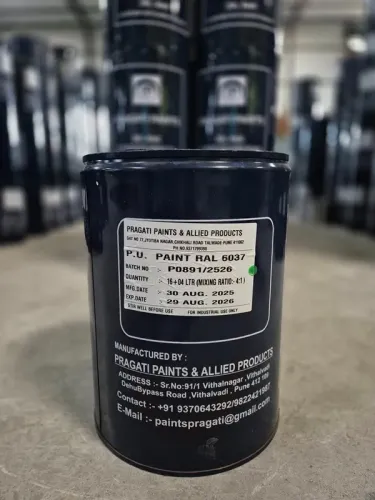
Pragati Paints & Allied Products can support that verification by matching the proposed primer and topcoat to the job record rather than treating every metal surface alike.
Related products
 | Industrial PU Paint P.U. Primer (Polyurethane Primer) is a high-quality base coat specially formulated to enhance adhesion, improve surface uniformity, and increase the overall... |
 | Industrial PU Paint High-Performance Anti-Corrosive Coating for Industrial Protection When it comes to long-lasting metal protection, P.U Zinc Phosphate Primer stands... View product → |
Frequently asked questions
How does Pune’s climate affect PU primer selection for metal?
Assess monsoon wetting, humidity, condensation, dust, industrial pollutants and chemical exposure. Covered indoor frames need less barrier protection than outdoor assets exposed to persistent moisture.
Which PU primer fits steel, galvanised metal or aluminium?
Choose a system tested for the specific substrate and existing coating. Steel needs corrosion-control preparation, while galvanised metal and aluminium require compatible adhesion and surface-treatment requirements.
What preparation and weather limits should you confirm?
Specify cleaning, rust removal, abrasive profile, surface dryness, application temperature, relative humidity, dew-point clearance and the recoat window before application.
Which application figures should you compare when buying PU primer in Pune?
Compare volume solids, recommended dry-film thickness, theoretical coverage, mixing ratio, pot life, touch-dry time, recoat interval, thinner requirements and full curing time.
Related products
 | Expoxy Paint Etch Primer – The Ultimate Solution for Superior Adhesion on Metal Surfaces When coating smooth, non-porous, or galvanized metal surfaces, achieving... View product → |
 | Q.D. Paints & Primer Q.D. Primer Fast-Drying Primer for Industrial & Metal Surface Protection In industries where speed, efficiency, and reliable protection are essential, Q.D. |
 | Industrial QD Paint Synthetic Primer – The Perfect Base Coat for Smooth, Durable & Long-Lasting Painting Results When it comes to painting metal, wood, or general... View product → |