
The words “synthetic paint” do not identify one fixed chemistry, performance level or coverage rate. Before comparing quotations, you need to know what is inside the coating, how it will perform on your substrate, and which technical documents make the supplier’s claims measurable.
Key takeaways
- Specify the binder, curing method, finish, colour and application method.
- Request solids content, recommended film thickness, drying times and coverage figures.
- Match the coating to your surface, exposure, temperature and preparation standard.
- Choose another system when chemical, heat or immersion resistance exceeds its limits.
What is actually inside synthetic paint?
“Synthetic paint” is not a complete formulation. It identifies a manufactured coating, but not whether the binder is alkyd, acrylic, polyurethane, epoxy or vinyl, or whether it cures by oxidation, solvent evaporation, moisture reaction or chemical mixing.
| Component | Function | What to verify |
|---|---|---|
| Binder or resin | Forms the continuous film and controls adhesion, hardness and chemical resistance | Alkyd, acrylic, polyurethane, epoxy or another named chemistry; one- or two-component cure |
| Pigment | Provides colour, opacity and some protective properties | Colour system, pigment volume concentration and finish |
| Solvent or thinner | Controls viscosity during application and leaves as the film forms | Type, permitted thinner and VOC measurement method |
| Additives | Adjusts flow, drying, anti-settling, corrosion resistance or surface appearance | Specified function and compatibility with the approved primer |
Request these synthetic paints specifications before comparing products:
- Solids by volume, density and viscosity, with test units and methods.
- Target wet-film thickness and dry-film thickness, plus the ISO 2808 measurement method where stated.
- Dry-to-touch, hard-dry and recoat times at named temperature and relative humidity; alkyd coatings cure through atmospheric oxygen, so cold, damp, poorly ventilated conditions or excessive film thickness extend these times.
- Pot life for two-component products, shelf life and storage-temperature limits.
- VOC in g/L with ISO 11890-1 or ISO 11890-2, the regulatory definition and jurisdiction.
- Approved substrate preparation, primer, recoat products and maximum substrate moisture or alkalinity.
- The technical data sheet, safety data sheet, batch or lot number, mixing instructions and application window.
The technical data sheet defines performance; the safety data sheet defines hazards and handling. A brand name, colour name or unexplained litres-per-area figure cannot replace these synthetic paint details.
Which synthetic paints specifications belong in a quotation?
A fair quotation names the binder chemistry, not just “synthetic paint”: alkyd, acrylic, polyurethane, epoxy, vinyl, or another resin system. It also states whether the coating is one-component or two-component, the intended substrate, exposure environment, finish, colour system, and complete coat sequence.
Request these synthetic paints specifications for every quoted product:
- Solids by volume, pigment volume concentration where available, viscosity, density, and VOC in g/L
- VOC test method, units, and regulatory jurisdiction; ISO 11890-1 or ISO 11890-2 results are identifiable references
- Target wet-film thickness and dry-film thickness, measured using methods covered by ISO 2808
- Touch-dry, hard-dry, and recoat times at a stated temperature and relative humidity
- Pot life for two-component products, shelf life, storage-temperature limits, thinning ratio, and application window
- Approved primer, surface-preparation standard, substrate moisture or alkalinity limit, and compatibility or recoat table
- Technical data sheet, safety data sheet, batch or lot number, and colour reference
Use one comparison basis rather than brand names or colour names:
| Quoted detail | Weak comparison | Fair comparison |
|---|---|---|
| Binder | “Synthetic” | Alkyd, acrylic, epoxy, or polyurethane |
| Coverage | Litres per square metre | Litres per square metre at a stated wet and dry film thickness |
| VOC | Unexplained number | Value with method, units, and jurisdiction |
| Corrosion claim | “For steel” | Complete system, film build, preparation, and ISO 12944 exposure category |
Synthetic paint supplier information is incomplete when it omits these figures. The SDS explains hazards; the technical data sheet defines performance. Comparing both documents prevents a cheap quote from hiding extra primer, thinner, or coats.
Will the coating work on your surface?
A coating works only when the substrate, preparation grade, primer and topcoat form one approved system. Your synthetic paint details should identify that system, not merely promise “metal protection” or “universal adhesion.”
| Surface | Preparation | Primer requirement |
|---|---|---|
| Steel | Remove oil and rust; specify ISO 8501-1 Sa 2½ blast cleaning or St 3 power-tool cleaning, surface profile and flash-rust limit | Use the approved corrosion-control primer; request the complete ISO 12944 system and atmospheric corrosivity category |
| Galvanised steel | Degrease, remove white rust, then abrade or sweep-blast without stripping the zinc | Use a galvanised-metal primer; direct application can peel |
| Aluminium | Remove grease and oxide, then abrade to a clean, keyed surface | Use an aluminium-compatible adhesion primer; ordinary steel primer can fail |
| Wood | Sand, remove dust, seal end grain and control moisture before coating | Use a wood primer or sealer; bare end grain absorbs paint unevenly |
| Concrete | Allow curing, remove laitance and dust, and check moisture and alkalinity | Use a masonry-compatible sealer; alkyd coatings can lift on fresh, strongly alkaline concrete |
| Existing paint | Scrape loose film, feather edges, clean, lightly abrade and test adhesion and solvent reaction | Use the approved tie coat when the old binder is unknown; stronger solvent coatings can soften or lift it |
Ask for the permitted recoat products and maximum substrate moisture or alkalinity. A supplier that gives only a nominal coverage rate leaves preparation and film performance undefined; require wet- and dry-film targets, checked using methods covered by ISO 2808.
How do drying time and coverage affect the real job?
A quoted “dry in 4 hours” is incomplete unless it identifies the endpoint, temperature, relative humidity and wet-film thickness. Touch-dry time means the surface no longer feels tacky; hard-dry time concerns handling; recoat time tells you when another layer will not disturb the first; full cure concerns final resistance.
| Claim | What it means | Why it matters |
|---|---|---|
| Touch dry | Surface resists light contact | The coating can still mark or wrinkle |
| Hard dry | Film tolerates handling | It may not accept another coat |
| Recoat interval | Next coat can be applied safely | Applying earlier can trap solvent or lift the film |
| Full cure | Film reaches stated performance | Service exposure before this point can cause failure |
Ask for the test conditions in the synthetic paints specifications: temperature, relative humidity, wet-film thickness and ventilation. An alkyd coating can remain soft in cold, humid, poorly ventilated conditions because it cures through oxidation, not solvent evaporation alone. Excessive film thickness also extends recoat time.
Calculate synthetic paint coverage from volume solids and dry-film thickness:
Theoretical spreading rate = volume solids (%) × 10 ÷ dry-film thickness (micrometres).
A coating with 50% volume solids at 50 micrometres therefore gives 100 m²/L in theory. Deduct losses from overspray, roller or brush loading, surface profile, porosity, stripe coats and unusable material; at 15% total loss, usable coverage becomes 85 m²/L. Multiply that rate by the litres purchased, then compare it with the measured area.
Reject any litres-per-area figure that omits its solids percentage, target dry-film thickness and loss assumptions.
When is synthetic paint the wrong system, and what should the supplier provide?
A single synthetic topcoat is the wrong choice for immersion, continuous chemical contact, high service temperatures, or severe corrosion exposure. Specify a complete coating system instead: surface preparation, primer, intermediate coat, topcoat and dry-film thickness, with the environment classified under ISO 12944.
| Exposure | Why a basic synthetic system fails | System to request |
|---|---|---|
| Continuous water or soil contact | Film blistering and underfilm corrosion | Epoxy system specified for immersion |
| Solvents, acids or alkalis | Binder softening, swelling or chemical attack | Chemical-resistant epoxy or novolac epoxy |
| Outdoor steel in C4 or C5 environments | Rapid rusting when film build and edge protection are inadequate | ISO 12944 system with the stated corrosivity category and durability range |
| Sustained heat above the product’s stated limit | Discolouration, loss of adhesion or cracking | Heat-resistant silicone or other temperature-rated coating |
Before placing an order, obtain this synthetic paint supplier information in writing:
- Technical data sheet stating binder chemistry, components, volume solids, density, target wet- and dry-film thickness, cure, application window and recoat interval.
- Safety data sheet, batch or lot number, shelf life, storage-temperature limits, and mixing or thinning instructions.
- Compatibility and recoat table covering the specified primer, substrate and existing coating.
- Theoretical synthetic paint coverage with its volume-solids basis and assumed dry-film thickness; compare it with practical losses from profile, porosity and application.
- Proposed ISO 12944 system and durability category where corrosion protection matters.
Pragati Paints & Allied Products can be asked for these documents before quotation approval, not after delivery.
Related products
 | Synthetic Paints & Primer Durable, Affordable & Versatile Coating Solution for All Surfaces Synthetic paints are among the most widely used industrial and household coatings... View product → |
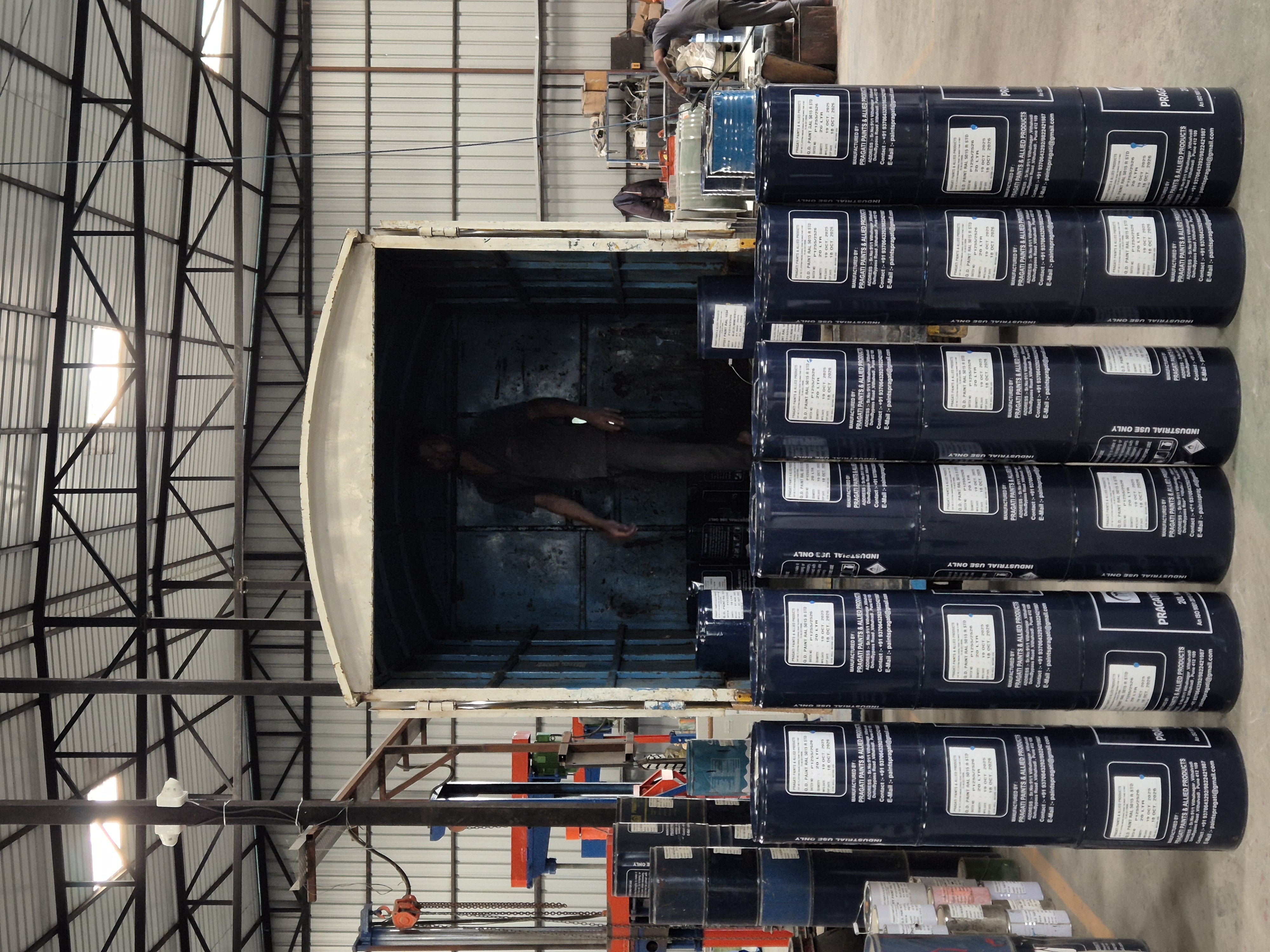 | Industrial QD Paint Synthetic Primer – The Perfect Base Coat for Smooth, Durable & Long-Lasting Painting Results When it comes to painting metal, wood, or general... View product → |
Frequently asked questions
What information belongs in a synthetic paint quotation?
Request the binder type, finish, colour, pack size, application method, thinner, recommended dry-film thickness, coverage, drying times, surface preparation and recoat window.
How do you check whether synthetic paint will work on a surface?
Match the coating to the substrate, existing paint, surface preparation, moisture, chemical exposure, temperature and required adhesion. Ask for a compatible primer when the system needs one.
Why do synthetic paint coverage and drying time matter on the job?
Coverage affects the quantity and labour you need, while drying and recoat times control site access, handling and project duration. Compare figures at the stated film thickness and temperature.
When is synthetic paint the wrong coating system?
Choose another system when the surface faces continuous immersion, severe chemical exposure, high temperatures, heavy abrasion or demanding corrosion conditions beyond the product's stated limits.